
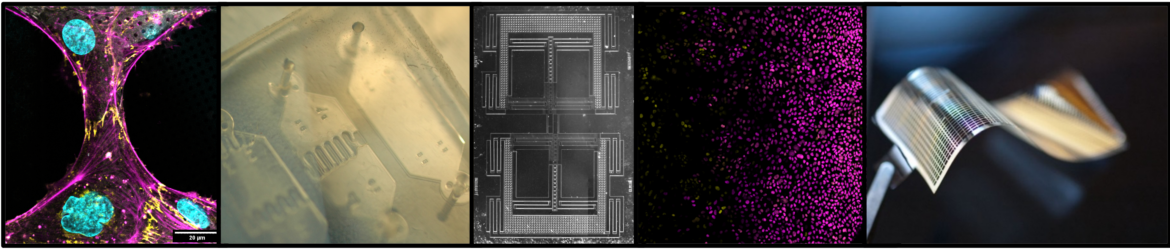
PhD: Polymer MEMS at Tel Aviv University
I conducted my graduate research with Dr. Yosi Shacham (Physical Electronics) and Dr. Slava Krylov (Mechanical Engineering) at Tel Aviv University. The main goal of my research was to develop MEMS based on electroactive polymers, smart materials also known as “artificial muscles”. I was initially drawn to the field of polymer MEMS due to its many applications for improving human life, such as tools for less invasive surgery, active prosthetics, and lab-on-a-chip devices.
A major challenge to the development of electroactive polymer MEMS lies in the integration of smart materials with microsystems. I developed fabrication processes for working with a range of electroactive polymers at the micro- and nano-scales, and microfabricated and characterized novel polymer MEMS. This work contributed to the “toolkit” of electroactive polymer actuator technologies by innovating new device architectures and providing a scientific basis for investigating the electromechanical properties of electroactive polymers in MEMS. My graduate research was recognized by several awards, including a prestigious award from the American Vacuum Society granted to one graduate student each year.
I also had the opportunity to work on several international collaborations that influenced my research direction and made interdisciplinary collaboration a hallmark of my academic style. In the European Union Heart-e-Gel Consortium, I characterized the electromechanical response of a novel biocompatible hydrogel developed for operation in cardiovascular systems [1,2]. Next, I collaborated with Dr. Gregory Washington’s group at UC Irvine to develop electroactive polymer actuators with integrated mechanical sensing [3]. Following a grant from the Sackler Fund for Convergence Research in Biomedical, Physical, and Engineering Sciences, I integrated electroactive polymers with microfluidic circuitry as a visiting student researcher in Dr. Liwei Lin’s lab at UC Berkeley [4].
At Tel Aviv University, I collaborated with Dr. Tal Dvir’s group to develop a freestanding cardiac patch for online monitoring and regulation of tissue function, which resulted in a patent and a publication in Nature Materials [5]. My role in this project was to contribute my MEMS expertise to fabricate a flexible microelectrode array compatible with cardiac cell culture. Upon observing the spontaneous contraction of cardiac cells, I realized that cells themselves are fascinating micro-machines with exquisite sensing and actuating capabilities! This collaboration strongly influenced my research direction toward applying the engineering methodologies I had mastered to the study of cell behavior.
Postdoc: Mechanobiology and cryo-ET at Stanford
I resolved to immerse myself in quantitative biology for my postdoctoral research. I was awarded a ChEM-H Mechanobiology Postdoctoral Fellowship to train with Drs. Beth Pruitt, Alex Dunn, and Bill Weis at Stanford University through their ongoing collaboration to study the molecular basis of how mechanical force affects cell-cell junctions. These labs created an ideal research environment for me to leverage my engineering background toward developing in vitro assays to study mechanobiology, while acquiring hands-on training in established biological research methodologies.
In the Pruitt lab, I contributed to the design of a silicon MEMS device for applying shear perturbation to epithelial monolayers [6]. Appreciating my enthusiasm for bio-microfabrication, Dr. Pruitt presented me with the challenge of controlling cell shape and position on delicate cryo-ET supports. In collaboration with the Hanein lab, I applied maskless photopatterning to innovate a robust micropatterning technology that enables high-resolution mechanobiology studies by cryo-ET [7], a method that is rapidly gaining traction in the field.
I was in awe of the power of cryo-ET to enable visualization of the preserved, internal structure of the cell, the most complex machine known to man, at unprecedented resolution. This emerging microscopy field presented the perfect opportunity for me to contribute my engineering expertise toward understanding cellular function. In the Dunn lab, I tailored my micropatterning technology to study the architecture of the intercellular junctions that connect endothelial cells, and quantified the ability of this technique to increase the rate of cryo-ET data collection [8]. These studies deepened my understanding of cell mechanics by considering cellular processes at the molecular level. In parallel, I established a productive collaboration with Dr. Kyle Loh’s lab, applying microfluidics to questions in developmental biology [9,10].
Engel Lab at the Technion
In October 2022, I joined the Faculty of Mechanical Engineering at the Technion and founded the Engel Lab for Bio-Microsystems. Our lab brings together my two research paths: we engineer micro-devices and micropatterned EM grids that control the cell’s environment, and use cryo-ET and live-cell microscopy to see how cells sense and respond to mechanical cues, with a focus on endothelial cell-cell junctions. Our work is supported by the Israel Science Foundation. Earlier support included a Michigan-Israel Partnership Grant and the Diane and Guilford Glazer Foundation.
Read about our current research →
References
*Equal contribution.
- Engel L, Berkh O, Adesanya K, Shklovsky J, Vanderleyden E, Dubruel P, Shacham-Diamand Y, Krylov S. Actuation of a novel Pluronic-based hydrogel: Electromechanical response and the role of applied current. Sens. Actuators B Chem. 191, 650–658 (2014). doi:10.1016/j.snb.2013.10.031
- Jackson N, Verbrugghe P, Cuypers D, Adesanya K, Engel L, Glazer P, Dubruel P, Shacham-Diamand Y, Mendes E, Herijgers P, Stam F. A cardiovascular occlusion method based on the use of a smart hydrogel. IEEE Trans. Biomed. Eng. 62(2), 399–406 (2015). doi:10.1109/TBME.2014.2353933
- Engel L*, Van Volkinburg KR*, Ben-David M, Washington GN, Krylov S, Shacham-Diamand Y. Fabrication of a self-sensing electroactive polymer bimorph actuator based on polyvinylidene fluoride and its electrostrictive terpolymer. Proc. SPIE 9798, 97980M (2016). doi:10.1117/12.2218383
- Engel L, Liu C, Hemed NM, Khan Y, Arias AC, Shacham-Diamand Y, Krylov S, Lin L. Local electrochemical control of hydrogel microactuators in microfluidics. J. Micromech. Microeng. 28(10), 105005 (2018). doi:10.1088/1361-6439/aacc31
- Feiner R, Engel L, Fleischer S, Malki M, Gal I, Shapira A, Shacham-Diamand Y, Dvir T. Engineered hybrid cardiac patches with multifunctional electronics for online monitoring and regulation of tissue function. Nat. Mater. 15(6), 679–685 (2016). doi:10.1038/nmat4590
- Garcia MA, Sadeghipour E, Engel L, Nelson WJ, Pruitt BL. MEMS device for applying shear and tension to an epithelium combined with fluorescent live cell imaging. J. Micromech. Microeng. 30(12), 125004 (2020). doi:10.1088/1361-6439/abb12c
- Engel L, Gaietta G, Dow LP, Swift MF, Pardon G, Volkmann N, Weis WI, Hanein D, Pruitt BL. Extracellular matrix micropatterning technology for whole cell cryogenic electron microscopy studies. J. Micromech. Microeng. 29(11), 115018 (2019). doi:10.1088/1361-6439/ab419a
- Engel L*, Vasquez CG*, Montabana EA, Sow BM, Walkiewicz MP, Weis WI, Dunn AR. Lattice micropatterning for cryo-electron tomography studies of cell-cell contacts. J. Struct. Biol. 213(4), 107791 (2021). doi:10.1016/j.jsb.2021.107791
- Cui KW*, Engel L*, Dundes CE, Nguyen TC, Loh KM, Dunn AR. Spatially controlled stem cell differentiation via morphogen gradients: A comparison of static and dynamic microfluidic platforms. J. Vac. Sci. Technol. A 38(3), 033205 (2020). doi:10.1116/1.5142012
- Engel L, Liu KJ*, Cui KW*, de la Serna EL, Vachharajani VT, Dundes CE, Zheng SL, Begur M, Loh KM, Ang LT, Dunn AR. A microfluidic platform for anterior-posterior human endoderm patterning via countervailing morphogen gradients in vitro. iScience 28(3), 111744 (2025). doi:10.1016/j.isci.2025.111744